Voices of the Past Video Netcast: Featuring Dave Moyer, teenage new media producer and historic preservation activist

Voices of the Past Episode 1: Transcript


Coming up in this edition of the Voices of the Past netcast, we’ll meet Dave Moyer. Moyer is a new media professional and a historic preservation activist. We’ll learn how he became involved in those efforts, and how he manages his role as founding president of Bitwire media … at just sixteen years old.


Welcome to Voices of the Past. I’m Jeff Guin. We’ll have that interview will be coming up for you in just a few moments. But first, here are a few briefs about heritage in the online world.

ONLINE HERITAGE RESEARCH CATALOG


The Oriental Institute at the University of Chicago is offering a wealth of downloadable research documents about the ancient Middle East at no cost. The material comes from the institute’s extensive collection which includes important academic books on the languages, history and cultures of the ancient Middle East.


The Oriental Institute first announced the Electronic Publications Initiative in 2004. The initiative’s mission is for all publications from the Oriental Institute to be published in print and electronically. The institute has published nearly 300 books since 1906. Topics range from dictionaries of the Assyrian and Hittite languages to oversized folio volumes that document Egyptian temples and tombs. Past volumes are being added online as funding permits.


Now, the Insititute says that the availability of free downloads has actually increased print sales by seven percent.


CONSERVATION WIKI


The American Institute for Conservation and its Foundation recently launched a collaborative wiki based on their conservation catalogs. The catalogs include descriptions of materials and techniques used to preserve and treat works of art and historic artifacts. These include topics such as books and paper, paintings, photographic materials, and textiles.


The site is based on the MediaWiki platform software that was designed for Wikipedia.org. This wiki will allow editors to work collaboratively to update the information. It will also ensure that innovative methods and materials are documented and widely disseminated to practicing conservators and conservation scientists.


The wiki was created with a grant from the National Center for Preservation Technology and Training.


HERITAGE VIDEO TRAVEL WEBSITE


For the past three years, Michael Phillips has had a dream that he hopes will someday spread to the rest of the world: to create usense of place with video. It seems the tech world has helped set the stage for that dream, incorporating video functionality into everything from mobile phones to music players. With his heritage travel site and blog, iGuidez, Phillips provides a template for capturing and sharing special sites for netizens everywhere to enjoy.


I recently spoke with Michael Phillips about his dream for the Voices of the Past podcast. Phillips talks about how he developed iGuidez and the challenges of running a heritage website. You can listen to his insights by visiting our shownotes site or by searching for us on iTunes.


FEATURED VOICE OF THE PAST: DAVE MOYER


While many sixteen year olds are obsessing about their next social event or prospects for college, one young man is taking a broader view. His name is Dave Moyer, and he is the founding president of Bitwire Media. Bitwire is a digital media content network that produces a variety of podcasts, websites and blogs featuring some of the world’s top new-media professionals.


But beyond his work as a prodigy in social media, he is also an active proponent of historic preservation. In fact, Moyer was one of the select few chosen across the country to work alongside First Lady Laura Bush in New Orleans during a summit with the History Channel and the Preserve America initiative. Since then, he has co-chaired three local and national summits promoting youth activism in historic preservation.


I had the opportunity to chat with Dave Moyer during a recent meeting of WordPress users. This is what he had to say about how he first became interested in podcasting, and the importance of teachers as heritage values advocates:


MOYER: I was lucky. In 7th grade, I went into the normal history class idea of “here we are, we are going to get the history textbooks an learn a bunch of facts and then forget them by the time its summer.”


I was ready for that. Then the first day, we learned primary sources. We learned Library of Congress, American Memory. We learned all of these places to get stuff, and I am like, “OK, this is a little different. What is this?”


By the spring we are asked by historic Denver because its teacher, Michelle Pierson is an incredible historic preservationist and educator at the same time. And she does both very well, and she gave us the opportunity to work with historic Denver on a project for the first annual Historic Colfax avenue marathon. And they said, “Alright, make us a brochure,” and we were like, “No, we are going to make a podcast.”


I just learned about podcasting, and so I came up and said, “Alright, what if we tried a podcast form?” And we posted…we recorded in conjunction with the Library of Congress’s teaching of primary sources, History Channel, a few other organizations. We recorded six podcasts on different areas of Colfax so that the runners could download these things onto their iPods and listen to them while they are running. So, we got within, probably the first couple of months over 100,000 downloads in the state of Colorado alone with these podcasts. We have gotten grants from Best Buy, the History Channel, it’s been national recognized as a program, and I have had the honor of being able to go down to New Orleans to work with First Lady Laura Bush on the first annual Preserve America Summit down there. I’ve worked with a bunch of other youth from the nation. I have co-chaired, I think there have been four now, of the regional Colorado Preserve America Youth Summits that have stemmed off of that as a separate endeavor. It’s been a great, great dream…it’s all snowballed. But it’s been awesome. I’ve had all those opportunities.


GUIN: So, you’ve been speaking at social media conferences, obviously, and you are here at WordCamp now. Have you added historic preservation conferences to your speaking schedule? Are you in demand yet as a speaker in those circles?


MOYER: There’s some of that. I’ve done, I came just recently, they had the state Preserve America Youth Summit, I talk about the Colorado Preserve America Summit and I work there, I’m speaking there, it is sort of a….. I do a couple things. I’ve done the National Trust for Historic Preservation, those kinds of things. Not as much as the social media, and that’s just kind of picked up as of late. But there are occasional times where I will go out there and be requested to talk about the student side of things and the tech side of things. Because that is what I live, that is what I do.


GUIN: So, do you find that sometimes maybe it’s a little harder when you’re dealing with people dealing with historic preservation that they seem a little distrustful or reticent with these technologies?


MOYER: Oh they do. There are all sorts of…well, a lot of historic preservationists are also the teachers, they are also the educators who have learned through their years and years of teaching that tech equals bad because it distracts kids in my classroom. So the cell phones have to be put away and taken away, and iPods have to be shoved in a box that they get back when its June. And really, there’s technologies…you can’t fight ’em. They come out of the closet.. from under the table, I know that. What you need to do is take that and turn it into a tool so that it is actually being an educational thing. I keep going back to Michelle Piersen. We’ve done wikis, we’ve done blogs in her history class. There was a kid who did a Ben Franklin’s blog because he came to Denver for the Ben Franklin museum and was touring around and trying to fit into modern society. All kinds of great, great stuff, and when you are taking it out of the text book and…and textbook worksheets, they have a horrible negative connotation with kids, you get such a better connection when you connect it to something that we know. Back in the 1920s, kids read nonstop, that was their life. Either they read or they go play down in the park. Now we listen to our iPods or we go play down in the park. You have to adapt as the kids are adapting. You have to adapt as the work is adapting, and it’s hard sometimes for some of the preservationists and some of the people who are active in this stuff to do that. That’s what we are trying to work on a lot, is show them that this is kinda works.


GUIN: So, are you doing…you mentioned the original series of podcasts. Are you following those up in any kind of way? Do you have plans to do more work with either podcasts or other forms of social media related to heritage preservation?


MOYER: We recently did a big project with the local veterans museum for World War II veterans, and we did podcasts associated with that, actual interviews with some of the vets there. There are lots of things that are always being worked on. We’ve not been able to do as much as we’ve liked to because of different issues associated with the museum there, and just as we were talking about before, curators who are stuck in the days of “we need to have a wall, and we need to have the glass behind it” and that’s all we can do. And sometimes that creates a roadblock, but there’s always stuff in the works and there are many many plans in the future on this…

GUIN: Now, Dave actually hosts several podcasts, including the WordCast, The Aimless Agenda Show, and the Best of the Net. Additionally, he is one of the few recipients of MITs Promise of the Future Award, which recognizes students for outstanding work and activism in the technology world.

Well, that’s it for this edition of Voices of the Past. If you are using the web to communicate heritage, we’d like to hear from you. Share your story with us by going to our Voices of the Past shownotes site. There, you can also find links to all of today’s stories. And, until next time, we’ll see you on-line.


Podcast: Michael Phillips on creating Sense of Place with video “iGuidez”

For three years now, Michael Phillips has had a dream that he hopes will someday spread to the rest of the world: to create “sense of place” with video. It seems the tech world has helped set the stage for that dream, incorporating video functionality into everything from mobile phones and music players. With his website and blog, iGuidez, Phillips provides a template for capturing and sharing special sites for netizens everywhere to enjoy. In this interview, Michael Phillips talks about how he developed iGuidez, and the challenges of running a heritage website.


Welcome to the Voices of the Past podcast. I’m Jeff Guin, and today I’m talking to Michael Phillips of the heritage travel site, iGuidez.

Guin: Michael, welcome to the podcast. I was wondering if you would just start by telling us what iGuidez was designed to do.

Phillips: My experience as a traveler has been that guide books only ever give you a paragraph or two or sometimes even a few sentences about a famous sculpture or a church or anything like that on a local level. And therefore, I was always one that I wanted more information, I wanted to know more about what I could go to see rather than think, “Oh, this is really those three stars or four stars, so I have got to go see it,” whereas maybe it’s not in your taste at all. So I’ve been trying to get more concentrated information out about single items that you can go and see on a local level.

iGuidez is all about local information. I am trying to explain things better with video and photos and written text all in the one page as you see on my website.

Guin: Alright, well, how did you come up with the name for your site?

Phillips: Ah, that was easy. It was a fluke. I mean, as you might appreciate yourself, trying to get a name for anything on the Internet these days is virtually impossible. So it took me a long time at the previous name I had was JungleJam.tv, basically because I couldn’t find another name. And then one day, I just had upon iGuidez with a zed, you know so, it just came. It just happened like that.

Guin: Obviously this is a mission for you. You’re kind of looking at this as your calling. What experiences in your past led you to create the site, just the concept for iGuidez?

P1030017

Phillips: Well, as I have said, I have traveled a lot. I am interested in the history, but not interested in history for history’s sake. And I am more of a–I suppose you could say–history in a social context, and that when I go around to see things, I want to know what was the artist thinking when they created something, or what was the designer or architect thinking when they designed a building or such. So it kind of evolved initially from a point of view of traveling somewhere and letting other people know what’s there. The most difficult thing about iGuidez that it took me a couple of years to create is how do you put so much information about one thing on a website, on a web page. So, it’s taken a year, two years to develop that method. And as I said, it all comes from traveling.

Guin: Well, were you a web designer in a previous life? Is that what you do professionally? Are you a tech person?

Phillips: I am actually an aircraft engineer, but that had nothing to do with the website itself. No, I just picked up basic HTML code as I began three, four years ago and various different websites. But then as it got more complicated and because it was video, I then had to employ certain people along the way. So the website now, I pay somebody to develop it to my ideas and designs. It’s a very expensive option. I mean, I wish I could do it myself because I would save a lot of money. I am only doing it because I can’t sit down and learn the website coding and also be out and making videos because it just doesn’t go. A lot of people have always said to me, “Why don’t you learn the coding then?” But then of course, who would be making the videos?

Guin: Exactly. And we know that the web is about the content, it’s not so much the look of the site, although good design is important, but there are some just very basic blogs that are very, very popular using the standard default WordPress template. It is about the content. What’s your experience with videography? Is it something you have done professionally in the past or is it something you have taken up as a professional hobby?

Phillips: Actually no. I have had no experience whatsoever in videography or photography or any of that at all … Having lived in Italy for four and a half years, in the world’s center of art, it’s hard to describe. You can’t write about art. You just can’t. It doesn’t translate as well, no matter how good a writer you are. So you have to show photographs; you have to show images, you know? So again, it was just playing around with video and thinking. Video is also much quicker. You put one photograph up of a piece of art and that’s it. Now you have to say something; write something about it. Whereas if you use a video, you can take much more art in and you can talk about it at the same time. So you are letting the images speak for themselves. So it was really just trial and error.

Guin: OK, well, you’ve got your blog established and your website, and they look great and they are very informative. But have you branched out to other forms of social media and using the web tools to communicate with your audience as well?

Phillips: Yes, I use Twitter as much as I can. I did have Facebook account a while ago, but I gave it up because you have your normal email and then you have the social media and then you have say the blog and the website, and it just gets so complicated and then you lose track of everything. I had to streamline everything. So I just use my blog on the website and Twitter as I can.

Guin: OK. Well, what does Twitter do for you as far as being able to promote your site and communicate with people that are interested in your blog?

Phillips: Well actually, that is a very good question. I asked myself that question when Twitter was all the go many months ago. I looked at it several times and I couldn’t think how am I going to use it because I’m not one of these people that I want to blog about me or my experiences. I wanted to use it for my website and I couldn’t figure out how. And then it just occurred to me one day: “I know what I’ll do, every time that I see something interesting or I make an interesting video or I add something to my blog, I can then update it on Twitter.” I do and sometimes it catches on. Sometimes it can be very useful, not always of course. And plus, the benefit of Twitter, as you have realized yourself, it is very quick. You just say what you have to say and press return and it goes out to everybody and that’s it. You don’t have to think about it, you don’t have to, like a blog, you don’t have to sit down and concentrate what you’re going to write or what you’re going to do. You just get on with it, and that’s again the advantage of it.

Guin: I am sure you spend some time on the Internet using resources on the web other than just your site or something directly related to it. What sites do you most enjoy?

Phillips: Well, I really enjoy TechCrunch. And I use a few similar sites. One called NI Tech Blog, which is a local one in Belfast. What I use them for is just to keep abreast of any announcements or anything that comes up similar to my website … just to know what technology comes online, or who’s moving or who’s doing what on the travel industry. And sometimes I do contact people through those websites to ask for collaboration and things like that.

At the beginning when I started of a couple years ago when I was getting more into the research and the information, I used to use Wikipedia a lot, but then I suddenly realized it has a very very short life span because there’s not a lot on Wikipedia with regards to specific information on local things. Now if you are talking about famous landmarks or points of interest, there is plenty. But not on local things. … There is one local website at home, the historian website that occasionally I use if I am back home and I am researching information.

Guin: As you demonstrate, there are different types of heritage sites and heritage blogs, and there can be photo blogs and there can be video blogs as well, and I’m amazed at all the content that you’ve got on your site. How long has it been in existence?

Phillips: Just over three years. I kind of kicked in again about travel. It was travel-oriented. And then in the last year, year and a half, it got really concentrated with information in that I want to show the information that I’ve researched about the particular subject that I happen to be videoing. That’s where I’m at today.

Guin: OK, well, explain how the site works. Is there anyway that people who enjoy your site and kind of connect to your mission can help you create more content for the site?

Phillips: Oh yes, definitely … One of the points of this website is to create a model. Again, if I hark back to that model of Wikipedia, I want to try to create some way so that I have the model to show other people how to do this, and of course, yes, I’d love people to copy what I’m doing. Again, just as in Wikipedia, there are rules and regulations. There is no point in just going around and videoing something and then talking about it, because that may not make a lot of sense. So I am looking to collaborate with people, and I am contacting travel organizations and travel websites and various technology companies even to explore ways how to develop this further. Not just from my point of view, but also in trying to get other people involved. So certainly, I mean, that’s an open question. Yes, I would love help because as much as I’d love to do everything myself, I can’t.

Guin: I understand completely. OK, then let’s use for example, let’s say there is a small Main Street organization here in the US, and they want to do some video or landmark documentaries on their particular town. Do you have any pointers for actually undertaking a project like that?

Phillips: Yes I do. In fact I occasionally have a blueprint of instructions for how to do it. For example, the videoing is not a difficult thing to learn how to do. And what I mean by that is, where do you start when you go into a room to video? Now I can explain that very easily. You just say: start at the entrance and you walk around in a clockwise direction or a counterclockwise, it doesn’t matter, and video as much as you can. So there are basic things like that you can explain with video. The much more difficult thing to explain is how do you get the information? Where do you get the information? Because if it is quite a popular thing or a famous landmark then it is not a problem. There is plenty of information out there, and even, for example, guide books, local guidebooks can even tell you as much as you need to know. But it’s things that aren’t well known that are probably even more historic; that have more value in a historic sense, and it’s trying to integrate that information onto the video in a way that makes sense.

Guin: Alright, well, if someone is interested in doing this, is there a place on your website they can go for more information or can they contact you?

Phillips: They certainly can. If they contact me, I’ll be happy to collaborate with anybody on this theme. I will certainly help anybody as much as I can because it’s in everybody’s interest to develop this, not just mine of course.

Guin: Tell us what your grand vision is for the future of this site, either in the next year or going into the long term. What do you hope for?

Phillips: Well … this is my calling, I think. It certainly feels like it. Although, with most personal missions, they never pay. So, I need something for that to change because it has taken everything off me. So I need some sort of commercial backing to help me along. I am trying to work with certain city councils in Belfast and also in Bologna because I have those two cities are very well covered. One other ambitious task at the moment is that I have made contact with the tourist board in Rome quite a few months ago, and they were very enthusiastic about my project because, I have covered Bologna (15:53) so much now and I have so much content on Bologna that I can’t really do much more. So I want to expand to the likes of Rome where I can actually meet more tourists myself when I’m on the street and they have taken us on board and have now passed it on to one of the government ministers.

Guin: Where are you from? I’m not recognizing an Italian accent there.

Phillips: Oh no, definitely, Belfast.

Guin: Do you consider Bologna your home base?

Phillips: I use Bologna as a model to create my video guides, and then of course I copied that over to Belfast every time I went home. So now that I have completed my mission there in Bologna, I need to move somewhere where it will have a greater significance and that will be the likes of Rome or in fact, it could be any big, any major city, but I know the Italian way now. I like the culture there obviously, and the standard of life, so I am happy to just to move to another city.

Guin: Well, is there anything else that you need to say about iGuidez or do you have any other web endeavors that you’re pursuing?

Phillips: God, you know, this is enough at the moment. Let me move forward with this before I go on to another one.

Guin: Alright, you kind of actually, if you have been doing it three years, you kind of got in it about the time that social media was just hitting. It is kind of the dawn of the revolution so to speak. So a lot of these social media tools weren’t even in existence then.

Phillips: Exactly. In fact, I was one, if not the first, to start making video guides. I draw a lot of inspiration from Wikipedia; drew a lot of inspiration from that then and thinking, there’s a lot of people collaborating together on knowledge. And I thought, it took me a while to think, well how could I create something that could be also equally valuable to somebody, you know? So again, that is what I want to do as well to draw upon other people’s experience and knowledge and try to put them all onto one database, so that other people can actually learn from it and actually see and experience it more. Whereas Wikipedia is text-based, not to devalue it in any sense or criticize it, it is just text. And how do you move that on to the 21st century? And that is what I think video is all about.

Guin: Well most people are visual. There have been a lot of studies about that and especially in today’s world with all of the digital distractions, that’s the only way to really capture the imaginations of anyone, but especially the younger folks. And those are the ones that we need to instill the heritage values into.

Phillips: That’s right. And there was even just a last point: there was an article written by the Times, the Sunday Times here in London about six months ago. In fact, I even have it quoted it on my website in the about page, and it says that the journalists find that everyone appreciates that Google is the number one search engine, but what few people expected was that YouTube became the second biggest search engine. And what that translates as that people are looking for videos for information now. They are looking into video websites for actual information, and that’s an extremely powerful thing if you think about it. Which means that anybody who actually has relevant information in a video, that someday is going to be worth a lot.

Guin: Alright, well, I think I am going to go ahead and wrap it up. It was a pleasure to talk to you.

Phillips: And to you as well.

Guin: And that was Michael Phillips of the heritage travel site, iGuidez. Now if you would like to learn more about Michael and iGuidez, you can check out our shownotes site. That’s Voicesofthepast.org. You can find a transcript of this interview. While you are there, check out our 2.0 tips for how to use social media to advance heritage in your part of the world. Until next time, this is Jeff Guin for Voices of the Past, and we’ll see you online.

Create your own heritage-themed social network in minutes with Ning


Sometimes the needs of a heritage group extend beyond the simple need to convey information. Blogs and Facebook fan pages allow limited interactivity. But for groups whose members are intensely passionate about a topic, a free social networking site like Ning could be the way to go.

So what is Ning, and who is using it to talk about heritage?

2945743633_fcfa8a6bc9_o

Essentially, Ning allows you to create your very own Facebook, complete with groups, design customization, forums, RSS capability and individual profile pages that incorporate blogs. There are also multimedia sharing functions whereby members can upload photos and videos.

According to Quantcast.com, an estimated 6.8 million people access Ning a month. Far fewer than Facebook, but you have to consider the quality of communication going on in these sites. Unlike the “drive-by” communication common to Facebook, Ning flourishes when ongoing, intense discussion is needed on a topic.

Compared to other social networking sites, Ning provides the a solid platform for effective, good-looking sites with minimal effort, according to TechCrunch.

There are several general factors to consider before starting a Ning site.

Pros:

  • You have an instant social network with a lot of the functionality of Facebook and your own brand
  • It’s customizable with colors, graphics and typefaces
  • There are a variety of privacy options for the site and for individual users
  • Feature set is continually improved.
  • Ability to track your web statistics through Google Analytics

Cons:

  • Unless your potential membership is highly prolific and motivated, you will have to manage your community intensively to keep the participation level up.
  • Once the information is in Ning, you can’t readily export it to another platform (like a blog).
  • There are hundreds of social sites out there and many folks are fatigued with signing up for them.
  • While Ning is improving, there will still be some instances (like getting a photo to show up in a post) where a rudimentary knowledge of HTML code is helpful.
  • It’s also your responsibility to deal with spambots and members behaving badly.

Participation often comes in waves. This may be affected by a major news item, event or recognition by other sites and blogs. Just prepare yourself for it.

Heritage organizations worldwide have joined Ning to share their values. Here are a few examples:

Natchitoches Preservation Network (collaborative small town heritage site)

Nat Pres

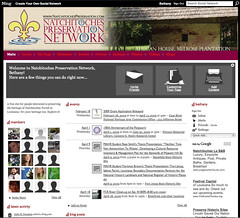
Natchitoches, La., the first permanent settlement in the Louisiana Purchase territory, is home to more than 30 organizations dealing with heritage issues. These organizations have long worked together to preserve the town’s historic legacy. While each has had its own website (often several years out of date) and publicity methods, the duplicate efforts wasted the energy of these organizations.

Ning was used to create the Natchitoches Preservation Network site.

The 151-member site uses groups and blogs to keep the community apprised of various heritage events and informs them of ongoing research and volunteer opportunities. Blog posts include anything from Community Cemetery Cleaning Day to thesis project presentations by Heritage Resources Students at nearby Northwestern State University of Louisiana.

The site also makes use of RSS and embedding of other social media to enhance the experience. It includes a virtual library of links from the social bookmarking service Delicious. It also incorporates a Friendfeed group that allows members to add news stories related to Natchitoches heritage from other sites, embedding them on the front page.

Members post photos and videos about events and places around the parish including the a series of “This Place Matters” videos in which individuals explain the importance of their favorite landmarks around the parish.

The site was also used to communicate intern research hosted at the National Center for Preservation Technology an Training during the summer. The interns blogged to the Natchitoches community weekly about the progress with their projects and how the projects benefit them as a community. They then presented their research at the end of the summer during the event “Preservation in Your Community.”

Heritage is more than just ensuring that a place matters, some heritage individuals find their passion preserving more intangible aspects, such as the art of music.

GenealogyWise (Genealogy Research)

gene

Genealogy is one of humankind’s favorite hobbies. We all want to know what makes us “us.” Not surprisingly, there are numerous genealogy networks on Ning. GenealogyWise is one of the largest. With more than 14,000 members and 3,000 groups, it’s very active. Using its group function, it also includes an interesting method for people to connect: by surname. The groups also tackle specific topics such as dating photos and outdoor genealogy. Nearly 400 videos (many of which are how-tos) have been posted. And to help the large membership connect, the site also holds scheduled live chats.

Museum 3.0 (Discussions on museums in the digital age)

museum 3.0 screen shot

Museum 3.0 poses the question, “What will the museum of the future be like?” More than 1,600 people from all over the world have joined in seeking an answer to this question.

The forums serve as their discussion board for a variety of topics including the future of the audio tour, new virtual tours on different sites, Twitter as a business tool and museum-related surveys.

Museum 3.o also uses the events function of Ning to promote different conferences, seminars and networking opportunities.

Museum 3.0 also uses Ning’s video and image sharing opportunities to post more than 500 images from different museums and about 50 videos ranging from interviews to museum-related speeches to videos depicting the “Reel Texas Cowboys.”

ning homepage

But heritage is not something that needs to be simply left to professionals. With social networking sites like Ning, heritage values are now in the hands of the individual.

For some, Ning enables them to research their family heritage and unit individuals globally giving them one centralized place to share aspects of their lives.  The families use their Ning sites to post family photos and videos, discuss family reunions and also research their family trees.

Regardless of the heritage you find important, let it be community heritage or your own family’s history, Ning enables you to share it all globally with folks who share those same values at the click of a button.

The sites we’ve covered are only a sampling of what’s out there. We’d love to hear your thoughts on your favorite heritage-focused Ning sites.


Enhanced by Zemanta