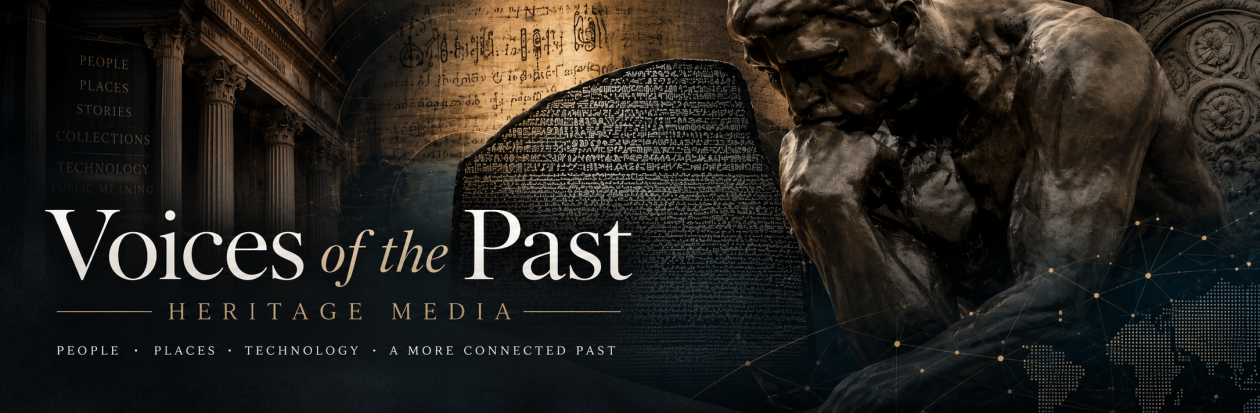
Voices of the Past is a cultural heritage publication and working archive by Jeffery “Jake” Guin, a technology strategist, writer, folklorist, and scholar-practitioner.

I started Voices in 2008 to explore what emerging digital technologies might mean for people working with history, preservation, museums, archaeology, folklore, and public knowledge.
In Fall 2026, I’m returning to that body of work—not as nostalgia, but to recover what is worth preserving, trace the questions that survived the technologies that first brought them into view, and test those ideas against the systems emerging now.
The archive is still being rebuilt. Old media is resurfacing, projects are being reconsidered, and new connections are becoming visible. There is more to come.
Voices now moves in two directions: Current Practice documents what I am learning, building, testing, and reconsidering in my own work, while The Voices preserves what other people know, practice, remember, and transmit through interviews, podcasts, video, and oral histories.
However you enter the archive—through a project, a person, a topic, a year, or a piece of media—you will keep arriving at the same five critical questions.
Fresh Perspectives
Recent writing and new insights from Voices of the Past.
★ Recent

Current Practice
A Modern Stoa
A visit to the remains of Athens’ Painted Stoa becomes the starting point for Workflow Studio, an experiment in creating space inside cultural institutions for people across roles to think, test, and adapt together.
★ Longread

Longreads · Ideas Across Time
Preservation Technology Podcast: Interviewing the Field as It Emerged
The Preservation Technology Podcast became a field notebook in audio: conversations with practitioners working across 3D documentation, conservation, sustainability, landscapes, and digital preservation as those practices were taking shape.
★ Recent

The Voices
Greg Baldwin: Memory and Activism in the AIDS Era
A two-day oral history with Miami LGBTQ+ activist Greg Baldwin became a layered public-history record combining video, full audio, transcript, contextual research, and links outward to the historical record.
Five Critical Questions
The technologies change quickly. The questions do not.
Who gets to speak, and whose knowledge is heard?
How new technologies redistribute voice, visibility, authority, and the ability of practitioners to participate in public knowledge.
How do we make knowledge more accessible without losing its meaning?
What happens when cultural knowledge becomes easier to reach, reuse, and separate from the people, places, evidence, and histories that give it context.
What happens when useful tools become systems we depend on?
How experiments become infrastructure, workflows, institutions, dependencies, and eventually part of the environment in which the work itself takes place.
How do we preserve memory when the systems carrying it keep changing?
What it means to preserve knowledge when websites disappear, platforms decline, formats age, interfaces change, and digital abundance creates its own forms of loss.
What should technology strengthen in us—and what should it never replace?
Attention, judgment, curiosity, interpretation, creativity, physical presence, agency, and the human capacities worth protecting as more of our intellectual work becomes technologically mediated.
Explore by Topic
Explore recurring ideas across the archive, from early experiments to current practice.
Public Knowledge
Oral History · Crowdsourcing · Genealogy · Archives · GLAM-Wiki · Digital Humanities · Heritage Education · Digital Heritage · Cultural Institutions · Institutional Learning · Explore more ideas →
Technology & Methods
Linked Open Data · 3D Documentation · Artificial Intelligence · Digital Preservation · Augmented Reality · Digital Archaeology · PreservationTech · Explore more ideas →
Legacy Media
Library of Congress Flickr Strategy (2010)
Early experiments in social media, public collections, and participatory knowledge.
Dale Jarvis on Storytelling and the Social Web (2010)
Place-based storytelling, folklore, and emerging digital media.
Voices Directory
The questions on this page are carried by people. Voices Directory gathers the practitioners, thinkers, storytellers, researchers, collaborators, and public voices whose work made these questions visible in practice.
Move from a critical question to the people who encountered it in the field, then back into their interviews, guest posts, projects, and collaborations. The same Voice may appear under several questions because the work itself rarely stays inside one category.
A Scholar-Practitioner Approach
I have come to understand this work less as a sequence of projects than as a recurring practice.
A shift appears in the field. I try something. The experiment produces evidence. Research and reflection help explain what happened. A principle begins to emerge. Then a new technology, institution, audience, or problem creates another opportunity to test it.
Observe → Experiment → Document → Reflect → Extract → Test Again
Practice generates questions. Research sharpens them. Reflection makes patterns visible. Then the ideas return to practice.
That is why the archive matters now. Not because every early experiment predicted what would come next. Not because every platform survived. And certainly not because everything fits neatly into a retrospective master plan. The value is in seeing which questions survived the technologies that first brought them into view.
New technologies keep giving us new ways to answer old human questions. The scholar-practitioner’s job is to test those answers in the world—and notice what they change.
Explore the Archive
There is no single correct way through this material.
Follow a Critical Question →
Trace one recurring human question across different technologies, projects, and periods.
Follow a Person →
Move through practitioners, thinkers, storytellers, collaborators, and interview subjects.
Follow an Idea Through Time →
Start with one artifact and see where the idea reappears under different technological conditions.
Browse by Year →
Use chronology without treating it as progress.
Explore Everything →
Enter the full Voices of the Past archive and make your own connections.