A Field Test for One
Nobody else showed up, but I’m not mad at it.
I headed down to South Miami for a FootWorks run, but this one had an additional purpose. My TrainingPeaks virtual trainer had me doing an F1 field test, four continuous miles that would give us something resembling an actual baseline instead of continuing to speculate about what kind of shape I was in. When I got there and realized I was on my own, I could have called it. Instead, I did the workout.
Truthfully, I was a little glad it was just me. It is hard for me to leave people behind, and I do not especially like slowing them down either. In a group, I tend to acclimate. I find the pace, the rhythm, the social contract of the run, and settle into it. Most of the time that is one of the things I like about running with other people. But for a field test, being alone was probably useful. There was nobody to chase, nobody to wait for, and nobody whose effort I had to account for. The result was mine, for better or worse.
Why This One Mattered
This was more than another five-mile run.
For much of the rebuild, I had been trying to interpret my fitness through individual workouts, how I felt that morning, or memories of what I used to be able to do. There had been enough detraining and inconsistency that even a good run could be difficult to place. Was I actually getting fitter, or had I simply caught a good day? Was a slower run evidence of a problem, or was Miami being Miami? I had plenty of impressions and not much of a baseline.
This was an attempt to change that.
The point of the field test was to give the training process something measurable. Not a race prediction, not a declaration that I was suddenly back, and certainly not a pace I was expected to reproduce every time I put on my basic Nimbus trainers. It was a controlled piece of evidence: what pace could I sustain across four continuous miles, and what was my heart doing while I did it?
That mattered because the rebuild was starting to become less about proving that I could still run and more about understanding the runner I actually was at that moment. From there, the training could respond to evidence instead of memory.
Four Miles That Mattered
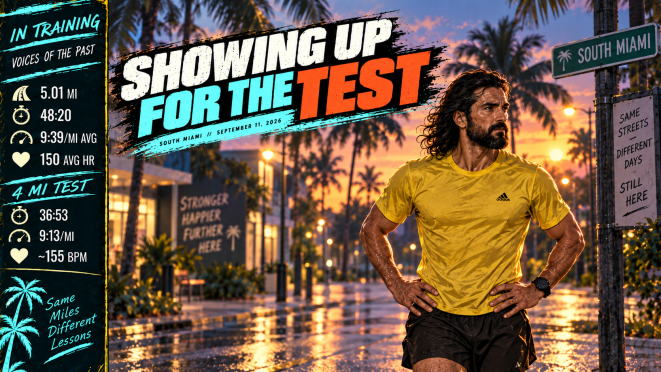
The whole run ended up being 5.01 miles in 48:20, averaging 9:39 per mile with an average heart rate of 150. The part we actually cared about was the four-mile test: 36:53.9, 9:13 per mile, at about 155 bpm.
That was interesting, not because 9:13 suddenly became my pace, whatever that means. One of the quickest ways to make running stupid is to take one good number and immediately turn it into an expectation. I’ve certainly done enough of that. But after months of wondering exactly what kind of fitness had survived the interruptions, here was something harder to argue away.
Four miles. 36:53.9. About 155 beats per minute. There was finally something to argue with.
What Does 9:13 Actually Mean?
This is where I can disappear down the rabbit hole pretty quickly. Was 9:13 good? Compared with what? What I could do before? What I should theoretically be able to do? Some race calculator? A younger version of myself who has become increasingly annoying in absentia?
Looking back through my own data answered the question more clearly than memory could.
| Date | Distance | Pace | Avg HR |
|---|---|---|---|
| May 20, 2025 | 5.25 mi | 9:02/mi | 152 bpm |
| Mar. 22, 2025 | 6.47 mi | 9:08/mi | 150 bpm |
| Aug. 27, 2026 field test | 4.00 mi | 9:13/mi | ~155 bpm |
| Apr. 1, 2025 | 4.06 mi | 9:15/mi | 153 bpm |
| Nov. 19, 2024 | 5.06 mi | 9:16/mi | 159 bpm |
| Nov. 14, 2024 | 5.07 mi | 9:19/mi | 157 bpm |
There was another detail hiding in that list: this was the only summer run among them. The others came from November through May. That does not make the comparison perfectly equivalent — weather varies from day to day — but in Miami, holding 9:13 pace at roughly 155 bpm in late August makes the result harder to dismiss as a favorable evening. If anything, the conditions make it a stronger piece of evidence that more fitness had survived the detraining than I realized.
The field test was not merely good for where I was in the rebuild. At 9:13 per mile and roughly 155 bpm, it sat right alongside some of my better sustained efforts from the previous couple of years. The comparison is not perfectly apples-to-apples — the field test is a four-mile segment while the others are whole-run averages — but the larger point holds. There was considerably more fitness under the rust than I had been giving myself credit for.
That changed the meaning of the number. 9:13 at roughly 155 bpm became a reference point, not a commandment. Once there was a baseline, later runs did not have to stand alone. They could be compared with something. If a similar effort eventually produced a faster pace, that would tell us something. If the same pace required less effort, that would tell us something too. If heat, fatigue or accumulated training pushed the relationship the other way, that was information rather than some grand verdict on whether I was fit or unfit.
For someone with a long history of letting individual runs acquire far too much psychological authority, that was probably useful.
Baseline, Not Verdict
So we kept the number: 9:13 per mile at about 155 bpm. Not something I needed to reproduce every Tuesday, and not a reason to turn an easy run into a race because Garmin happened to be showing me numbers I liked. Just a stake in the ground.
That became important to the larger process. The goal was no longer simply to string together better runs and hope confidence followed. We could start watching what changed over time: pace, heart rate, endurance, and how the body responded to heat, hills, fatigue and recovery. The field test gave all of that a point of comparison.
It also gave me something I badly needed at that stage of the rebuild: evidence that showing up consistently might actually be producing something.
I had gone to South Miami expecting a group run and found an empty start instead. That turned out to be fine. Maybe even better for what I needed to do that morning.
Nobody else showed up. I did.
Training data
- Date: August 27, 2026
- Workout: F1 / LT field test
- Total distance: 5.01 miles
- Total time: 48:20
- Average pace: 9:39/mi
- Average heart rate: 150 bpm
- Four-mile test: 36:53.9
- Test pace: 9:13/mi
- Average test HR: ~155 bpm
RUNNING FOR PARKINSON’S
Today was more like a quiz compared to the big test I’m working toward. I’m running the Philadelphia Marathon as a Parkinson’s Foundation Champion, and all these fairly unglamorous miles are part of getting me there. If you’d like to support the Parkinson’s Foundation along the way, you can donate through my Philadelphia Marathon fundraising page.
Leave a Reply